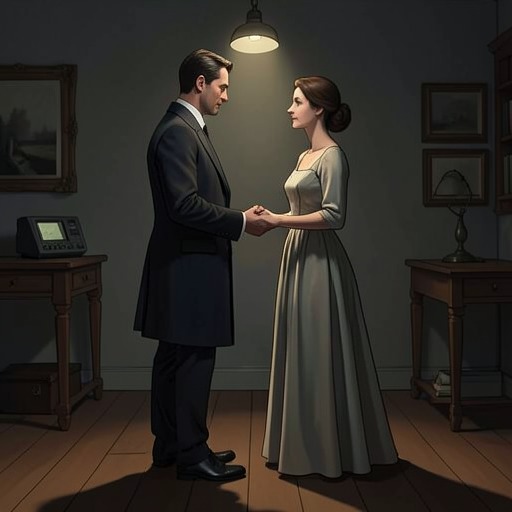
Tad
One Thousand and One NightsTad is an avenging agent of Lady Love whose confidence in his own investigative importance repeatedly outruns his understanding of both the case and his partnership with Claire. He pursues clues across realms, but the investigation’s decisive turns depend on what he learns from others and on the work he and Claire undertake together. His arc makes the mystery a test not only of deduction, but of whether he can relinquish the belief that he must be the indispensable one.
Identity and Introduction
Tad is introduced at home, trying to mind his own business when Sev and Pip summon him. Their persistent pecking begins at his study window and becomes a pounding at the door; he eventually opens it to find the two visitors sitting at his feet with an air of innocence. His irritated suspicion that they made him get up for their own amusement establishes a comic, self-regarding edge before the case begins.
That self-regard extends to his understanding of his position. When he hears that Claire may already have solved the case, he insists that he is the avenging agent and describes Claire as an assistant or agent in training. Nan corrects him: Lady Love made both of them avenging agents. Tad’s claim to seniority is therefore not the arrangement he imagines, and the discrepancy becomes central to his conflict with Claire.
The Case and the Wager
Sev identifies the assignment as a friendship-to-true-love case. Claire immediately draws an analogy between that problem and the pair’s own years without falling in love; Tad calls the idea improbable. Her romantic interpretation and his dismissal reveal their different habits of reading a situation before their formal dispute even begins.
Claire then accepts Tad’s challenge to compare their methods. She frames the case as a test of whether science or romance works better, objecting to the supposedly unscientific character of his reliance on poetry and related ideas. Tad welcomes the contest and proposes that the loser admit defeat, while Claire asks who will judge. The wager turns an investigation into a contest over authority: each is trying to demonstrate that their way of knowing is superior, even as the case calls for them to share its work.
Tad’s investigative drive is not merely competitive. He magicks himself to the place where the Magic globe had shown Zaen, hoping to obtain a clue before sunset and unwilling to let Claire go to bed believing she had already won. But his visit reveals a mismatch between the image and the moment he arrives: the outskirts of Shub-Haramb are dark, and the globe had shown what Zaen had been doing earlier, not what he was doing then. Hungry after missing lunch and creeping toward the trees, Tad hears an elfin voice celebrating that Della’s father cannot calculate. He squints through the moonlight at a small hooded figure dancing on a log. The excursion furnishes a clue, but it also demonstrates how his determination can bring him into a scene before he understands its timing or meaning.
The Hidden Story Behind the Case
The case reaches backward to a bargain between Della’s father and a jinn. In the account later considered during the investigation, the father explains that Della is already beginning to lose her memory under the jinn’s hold. The jinn possesses his mother’s necklace and his father’s ring as proof of his claim; when Della turns twenty-one, he will claim her, and her inheritance will pass to him. The father connects the danger to his own third wish to put the jinn back in the lamp, after which the jinn disclosed the terms of his demand for the father’s firstborn child.
The father also recognizes the failure in his own bargaining. He had been an orphan and a street child, and his first wish gained him knowledge of how to obtain wealth rather than wealth itself. He used his third wish to imprison the jinn again, but made a third promise before learning what it required. His wife suggests that the jinn may only be able to spin straw into Fairy gold, and that Della—not the treasure—could be what he wants. The father suspects the inheritance is involved but cannot resolve the jinn’s motive. Tad’s investigation thus concerns overlapping forms of power: the old bargain, the threatened inheritance, and the approaching birthday deadline.
Searching the Library of Love for more than an hour, Tad finds that jinns, or genies, are described as half fairy and half something else, mischievous and unpredictable, and capable of either helpful or harmful behavior. He also finds a story about a miller’s daughter tricked by a creature that spins straw into gold, though that tale mentions no lamp. The research gives him a possible connection, not a complete identification; fatigue overtakes him before he has solved the discrepancy.
When Claire arrives exhausted, Tad tells her what he has found and explains that Della may become the jinn’s property at twenty-one, leaving them less than a day to solve the case. Their weariness leads them to magick themselves to a crowd where a merchant offers jewelry to anyone who can guess his name. Tad recognizes the challenge as the one in the miller’s-daughter story, remembers that the name starts with an R, and cannot recall the rest. The shared scene moves the investigation from a tentative resemblance in a library book toward a specific suspect and a material clue.
Evidence, Capture, and Resolution
The suspect is Rumpelstiltskin, whose offer of gold necklaces and bracelets in exchange for a correct guess at his name recalls the story Tad has been trying to identify. The case’s folklore resemblance is confirmed when Tante Iezavel recognizes the spinning wheel Tad bought among Claire’s science projects and identifies it as the only one of its kind. Rumpelstiltskin cries out that it is his wheel and stomps his foot.
The confrontation also discloses a family relationship that changes the apparent shape of the case. Paribanou, Tante Iezavel’s sister, steps forward with fairy wings and rebukes Rumpelstiltskin for offering people what he spun on the wheel while pretending it was gold. She says he knows humans cannot tell the difference. Tante Iezavel identifies Paribanou as her sister and Rumpelstiltskin as their brother, then demands that he abandon his disguise. The apparent merchant is not simply a figure borrowing a familiar folktale trick: he is a relative of the fairy women, and they can confront him as well as expose his deception.
After the two jinns take Rumpelstiltskin into custody and remove the curse on Della, Tad is so tired that his immediate concern is to finish the last chore and sleep. Claire insists on accompanying him to close the case. They find Zaen questioning locals and tell him that the jinn has been captured, so they will take the lamp. Claire holds out her hand; Zaen clutches the lump beneath his shirt and looks between them. The exchange brings the lamp back into the investigation’s present stakes: capturing the jinn does not by itself complete the agents’ work, and Zaen has the object they have come to retrieve.
Tad’s earlier glimpse of Della’s father and Zaen in the Magic globe supplies a further piece of the hidden arrangement. The father lights two candles, takes one to a pile of straw, and speaks the password Open sesame. A rug lifts to expose a staircase; the men descend into a chamber filled with treasure. Zaen observes that the thief did not take very much. The passage connects the case’s theft and inheritance questions to a concealed treasure room, while making the password and the men’s descent concrete parts of what Tad has to piece together.
Partnership and Narrative Role
The rivalry over scientific method and romance is also a struggle over how Tad values Claire’s contribution. When Lady Love reveals that she has secret informants, she explains that she instructed Sev, Pip, Nan, and Wigamus to leave the two agents to their own devices so they could learn their lesson. The informants were not the source of her knowledge; she had been observing the partners’ choices. She challenges their assumption that she would side against one servant or decide which was more valuable, and points out that they have endured an ordeal only to return to the question of which of them matters more.
Lady Love’s assessment reverses the hierarchy Tad had asserted at the start. He had treated himself as the real agent and Claire as his subordinate; her verdict is that neither is more important than the other, and that Claire cannot solve a case without Tad. The correction does not erase their differences in approach: their wager had made those differences explicit, and their investigation crossed between Tad’s folktale recognition, the Library of Love’s research, and physical clues such as the spinning wheel and the lamp. It instead locates their effectiveness in the partnership their contest had put under pressure.
Tad’s role is consequently both detective and participant in the lesson the case stages. His curiosity propels him to pursue leads across realms, and his recognition of the name-guessing challenge helps connect the suspect with the miller’s-daughter story. Yet the case repeatedly exceeds a solo investigator’s reach: its explanation involves the father’s past wishes, the jinn’s claim on Della, the hidden treasure, and the intervention of Tante Iezavel and Paribanou. In a story that tests romance against scientific method, Tad’s development turns on a related distinction: being clever enough to find a clue is not the same as being the only person whose insight matters.